

Florida's Housing Market: Looking Beyond the Headlines
Florida Leads in Listings — But What Does That Really Mean?
I recently came across an image circulating on social media claiming that one out of every seven homes listed for sale in America is located in Florida.
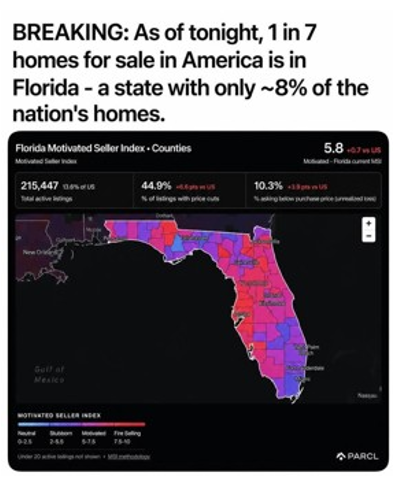
My first thought was simple: Is that really true?
And if it is, what does that actually mean for Florida's housing market?
Rather than accepting the headline at face value, I decided to look into the numbers.
According to Realtor.com's September 2026 housing inventory data, Florida accounted for approximately 12.6% of active listings nationwide. That's closer to one in eight homes than one in seven.
Could the original image have been accurate when it was created? Possibly. Housing statistics change constantly, and without a clearly identified reporting date, it's difficult to determine exactly what the image represents.
But here's what interests me even more.
Even if the one-in-seven figure were accurate, does that mean Florida's housing market is in trouble? Are property values about to collapse? Do buyers suddenly have the upper hand?
Not necessarily.
Numbers tell us what's happening. They don't always tell us why—or what those numbers mean for the people buying and selling homes.
And there's something else worth remembering.
Wakulla isn't Miami.
Before reacting to any statewide headline, we need to understand what's happening in our own communities.
More Listings Don't Automatically Mean Falling Prices
Remember what happened during the pandemic housing boom?
Buyers competed for properties, multiple offers became commonplace, and some purchasers waived inspections or other protections just to secure a home.
Those conditions weren't necessarily healthy or sustainable.
Today's market is different.
Yet something interesting has happened: while national inventory increased from September 2025 to September 2026, Florida's active listing count actually declined over that same period.
Florida Realtors also reported that statewide existing single-family median sale prices increased modestly in September 2026, even as closed sales slowed.
So having the largest number of listings doesn't automatically tell us whether a market is improving or declining.
We need to understand supply, demand, pricing, affordability, and how quickly homes are selling.

What Does This Mean for Buyers?
Depending on the community and price range, buyers may find opportunities to compare properties, negotiate repairs or concessions, and make decisions without the intense pressure experienced during the peak of the housing boom.
But having choices doesn't mean abandoning caution.
Mortgage payments, property taxes, homeowners insurance, flood exposure, and ongoing maintenance costs all deserve attention before making an offer.
An affordable purchase price doesn't necessarily mean an affordable property.
And a home that has been listed for several months isn't automatically a bargain. There may be legitimate reasons it hasn't sold.
The right questions matter more than the headline.
What Does This Mean for Sellers?
For sellers, the lesson is equally important.
Pricing a property correctly from the beginning matters.
A beautifully maintained home can still sit on the market when its asking price doesn't reflect current conditions.
Buyers have access to listing histories, comparable sales, and information about competing properties. Many are paying close attention to total ownership costs.
Presentation, marketing, property condition, and pricing strategy work together.
Yesterday's sales price doesn't necessarily establish today's market value, and repeatedly reducing an unrealistic asking price is not always the best substitute for a sound initial strategy.
Every Market Is Local
Here is the point I want buyers and sellers to remember most.
Florida is not one housing market.
Miami isn't Tallahassee. Tallahassee isn't Crawfordville. And a coastal vacation property in Franklin County isn't necessarily going to behave like a residential home in Wakulla County.
Even within the same county, conditions can vary significantly based on property type, location, acreage, condition, and price range.
A home on several acres may appeal to a very different buyer than a subdivision home. A waterfront property may face considerations that don't apply to an inland property.
That is why statewide statistics are useful for understanding broader trends, but local market data should guide individual decisions.
Look Beyond the Headline
Whether you're buying, selling, or simply keeping an eye on the value of your home, don't let one dramatic statistic make the decision for you.
Look at recent comparable sales, current competition, available inventory, time on market, and the circumstances affecting your particular property.
A changing market isn't automatically a bad market.
Sometimes it simply means buyers and sellers need to adjust their expectations, ask better questions, and make more informed decisions.
Numbers tell us what's happening. Understanding what they mean is what helps us move forward.
Data reference: September 2026, Realtor.com housing inventory data and Florida Realtors statewide market report. Statewide figures are not a substitute for current local MLS information.
#KartalHomes #FindYourWayForward #FloridaRealEstate #HousingMarket #MarketUpdate #HomeBuying #HomeSelling #RealEstateTips #BuyerTips #SellerTips #HousingInventory #WakullaCounty #LeonCounty #FranklinCounty #RealEstateEducation #WaypointProperties @WaypointProperties