

who Owns The Rain?
When does protecting natural resources become controlling private property?
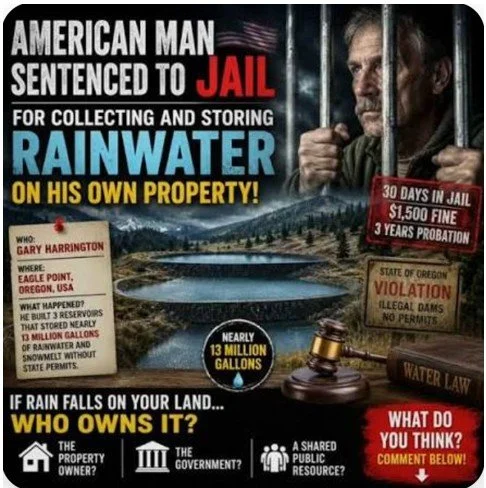
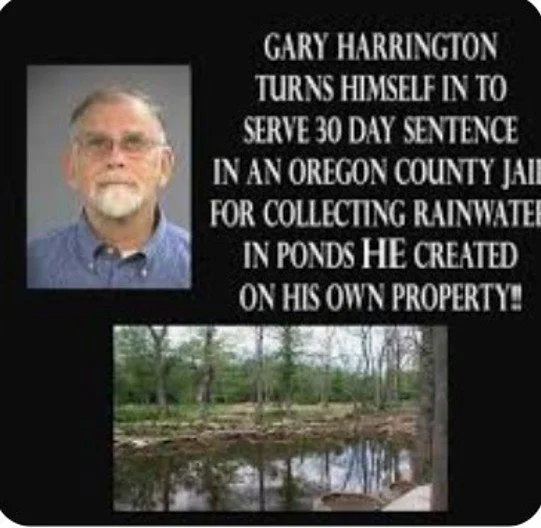
Every once in a while, a story resurfaces that makes people stop and ask, "Can that really happen?" One of those stories involves an Oregon landowner named Gary Harrington, who became the center of a years-long legal battle over rainwater collected on his own property.
The internet often summarizes the story as, "A man was arrested for collecting rainwater." While that's technically based on a real case, it leaves out much of the context.
Harrington wasn't collecting rainwater in a few barrels behind his house. He owned approximately 170 acres and constructed three reservoirs by building earthen dams across natural drainage areas on his property. Those reservoirs were capable of storing roughly 40 acre-feet of water—about 13 million gallons—and were used for purposes including irrigation, fire protection, and recreation.
The State of Oregon argued that, even though the rain and snow fell on his property, the stored water was part of a protected watershed and therefore subject to Oregon's water-rights laws. Harrington disagreed, believing he should be allowed to capture and use precipitation that naturally fell on his own land.
The courts ultimately sided with the State.
Whether the courts correctly interpreted Oregon law isn't really what interests me.
What interests me is the broader question.
Who owns the rain?
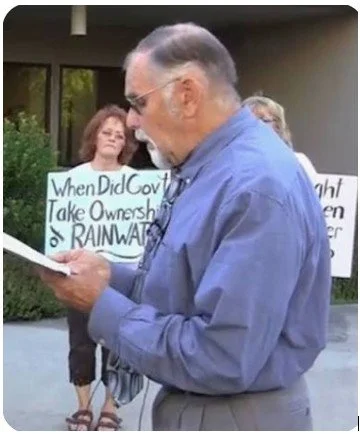
If rain falls naturally onto privately owned land, should a homeowner have the right to capture and use it? Or does the state have the authority to regulate that water because it eventually becomes part of a larger watershed serving downstream communities?
Reasonable people can disagree.
For me, this isn't simply about water rights. It's about where we draw the line between protecting shared natural resources and respecting private property rights.
If Mr. Harrington had diverted a river, blocked a natural stream, or taken water that belonged to downstream users, I could understand government intervention. Those actions directly affect other people.
But rain that falls naturally onto private property feels different to me.
I believe a property owner should have the right to collect and use rainfall that nature places on their land, provided they are not depriving others of water or causing measurable harm to neighboring properties or the environment.
Conservation matters. Responsible stewardship of our natural resources matters. We all benefit from healthy rivers, clean water, and sustainable ecosystems.
At the same time, one of the fundamental principles of private property ownership is what real estate professionals refer to as the bundle of rights — the collection of rights traditionally associated with owning property, including the rights to possess, use, enjoy, exclude others from, and transfer that property, subject to lawful regulation. Our Constitution likewise reflects the importance of protecting individual liberty and private property by recognizing, among other things, the right of the people to be secure in their persons, houses, papers, and effects, and by requiring that government action affecting life, liberty, or property be carried out through due process of law.
As governments adopt more regulations affecting how landowners use their property, many people naturally begin asking where the proper balance lies between legitimate public interests and the rights that have long been associated with private ownership.
That question extends beyond water.
Across the country, communities continue to debate land use, food production, hunting, fishing, environmental protection, and private property rights. While each issue has its own facts and legal framework, they all raise the same fundamental question:
How much authority should government exercise over the use of privately owned land?
There are no easy answers.
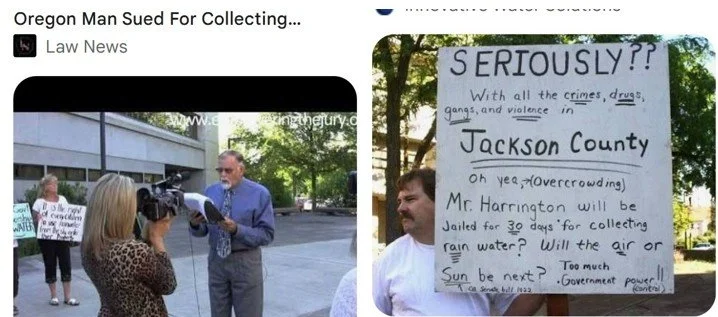
My concern is that, over time, we may gradually become accustomed to accepting increasing levels of regulation without stopping to ask whether each new restriction is truly necessary, appropriately tailored, and respectful of individual property rights.
Whether you agree with Oregon's approach or not, the Harrington case reminds us that these conversations matter. They deserve thoughtful debate, informed by facts rather than headlines, because once the balance between public authority and private rights shifts, restoring that balance is rarely easy.
As a real estate professional, I believe private property carries both rights and responsibilities. Protecting our natural resources is essential, but so is preserving the freedoms that have long defined property ownership in America. Finding that balance is one of the great challenges of our time.
I'll leave you with a thought from one of America's Founding Fathers:
"Those who would give up essential Liberty, to purchase a little temporary Safety, deserve neither Liberty nor Safety."
— Benjamin Franklin
What do you think? If rain falls on your property, should you have the right to collect and use it?