

The House Is Easy - But People?
Understanding the Person Is the Real Challenge
When most people begin buying or selling a home, they naturally focus on the obvious things: price, location, inspections, financing, and negotiations. Those are all important, but there is another element that often determines whether a transaction feels smooth or stressful.
Communication.
Over the years, I've learned that people don't all receive information the same way. One client wants photographs, maps, and spreadsheets. Another wants to sit across the table and talk through every detail. Someone else simply needs to walk through a home quietly before they know whether it's the right one.
None of these approaches are right or wrong.
They're simply different.
As a Realtor, recognizing those differences isn't a sales technique—it's part of providing good service.
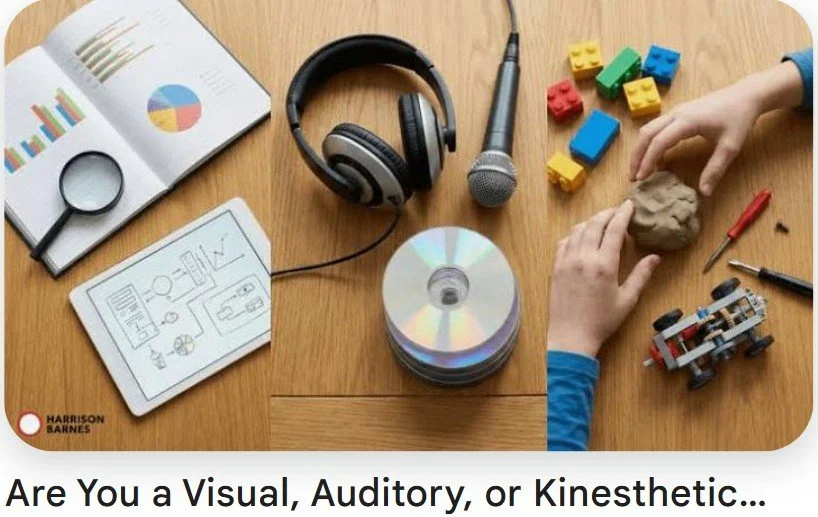
The communication styles discussed below represent one framework for understanding how people process information and make decisions. While no one fits perfectly into a single category, recognizing these general tendencies can help buyers, sellers, and real estate professionals communicate more effectively.
————————————————
A Personal Observation
Over the years, I've also learned something about myself.
When I'm studying for a licensing exam, learning a new real estate concept, or researching an important topic, I don't rely on just one method. I learn best when I can listen to an instructor, read the material being presented, write my own notes, and then review those notes later. Each step reinforces the others, helping me understand not just the facts, but how they fit together.
That experience has taught me that most people don't fit neatly into a single category. While one communication style may be more dominant in a particular situation, many people understand and retain information best when they can see it, hear it, and actively engage with it. The categories below are simply one framework for understanding communication styles—not labels that define who we are.
————————————————-
The Client Who Sees Everything
Some people process information visually.
Before they've even stepped through the front door, they're studying the curb appeal, landscaping, roofline, and neighborhood. They appreciate floor plans, aerial photographs, comparable sales charts, maps, and pictures that help them understand the property before they ever visit.
They often make quick first impressions because they naturally think in images rather than long verbal explanations. They appreciate concise information supported by photographs and visual comparisons.
When I'm working with a visual client, I know that showing is often more effective than telling.
Visual Clients

· Are picture makers.
· They notice curb appeal before they notice square footage.
· They love floor plans.
· Maps.
· Neighborhood photos.
· Drone videos.
· Comparable sales graphs.
· You don't convince them with words.
· You show them.
Visual people tend to think in pictures, process information quickly, appreciate graphs and visual data, and often judge by what they see.
Your Realtor should recognize when a client processes information visually and be prepared to provide photographs, floor plans, maps, market statistics, and other visual resources that transform information into understanding rather than simply presenting facts.
——————————————————-
The Client Who Needs the Conversation
Other clients process information by hearing it. These buyers and sellers ask questions—not because they're uncertain, but because talking through the details helps them organize their thoughts.
They appreciate explanations.
They often want to know why something works, how a contract clause protects them, or what typically happens next.
Your Realtor shouldn't become impatient when questions continue. In many cases, the conversation itself is part of the decision-making process. The Sandler material describes auditory communicators as people who process experiences through dialogue, enjoy discussing issues, and appreciate spoken explanations.
For these clients, communication builds confidence.
Auditory Clients
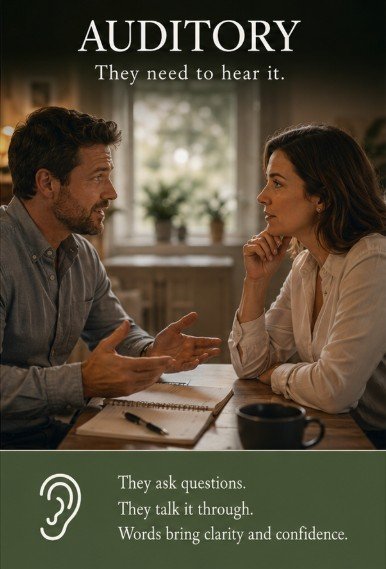
· These buyers need conversation.
· They ask questions.
· Lots of questions.
· They'll often repeat your answers back to themselves.
· They're not trying to be difficult.
· They're making sense of information by hearing it.
Auditory people as thriving on spoken explanations, liking to talk through issues, and appreciating dialogue and vocal expression.
Your Realtor should never view thoughtful questions as an inconvenience. Instead, they should welcome every opportunity to explain the process, answer concerns, and ensure that each decision is made with confidence rather than confusion.
————————————————————
The Client Who Needs to Feel It
Then there are clients who experience a property emotionally.
They walk slowly.
They spend extra time standing in a kitchen or sitting on a back porch.
They aren't measuring square footage.
They're asking themselves something much deeper.
"Can I picture my life here?"
These clients often describe homes using words like:
"comfortable."
"peaceful."
"welcoming."
"It just feels right."
The Sandler notes explain that kinesthetic communicators tend to evaluate experiences through feelings, patience, and personal connection rather than simply visual or verbal information.
Sometimes the quietest showing tells me more than the busiest conversation.
Kinesthetic Clients

· These are the people who quietly walk through a house...
· ...and then stand in the kitchen for five minutes.
· They're feeling the space.
· Can they picture Sunday morning coffee here?
· Does the home feel peaceful?
· Can they imagine grandchildren running through the backyard?
Kinesthetic people evaluate experiences largely through feeling, prefer a slower pace, and often respond best when information is connected to emotion and lived experience.
Your Realtor should recognize that not every buying or selling decision is made with statistics alone. Sometimes the greatest service they can provide is allowing a client the time and space to experience a property in a way that feels right to them.
————————————————————-
Why This Matters
Buying or selling a home isn't simply a financial transaction. -- It's one of life's major transitions.
Families are leaving memories behind.
Couples are beginning new chapters.
Investors are making business decisions.
Retirees are simplifying decades of life.
Every person standing in front of me arrives with different experiences, different priorities, and different ways of processing information.
My responsibility isn't to convince someone. It's to understand them.
That means adapting my communication rather than expecting every client to communicate like I do.
Sometimes that means preparing detailed market reports.
Sometimes it means sitting down over coffee and answering questions.
Sometimes it means simply giving someone enough quiet time to imagine themselves living in the home.
A Realtor who insists that every client communicate the same way can unintentionally create confusion or frustration because people don't all make decisions the same way.
A Lesson Beyond Real Estate
This isn't just useful when buying or selling a house.
Understanding communication styles can improve relationships with family members, coworkers, clients, neighbors—even complete strangers.
When we recognize that another person isn't being difficult but simply processes information differently, patience often replaces frustration.
Listening becomes easier.
Conversations become more productive.
Trust grows naturally.
Final Thoughts
The perfect home isn't found only by looking at listings.
It's found when someone feels heard.
Whether you're buying your first home, selling one you've loved for years, or simply beginning to explore your options, remember that the best real estate experience starts with communication.
Every house has a story.
Every client does too.
My job is to understand both.
And better relationships almost always lead to better real estate decisions.
About the Communication Styles
The concepts discussed in this article are adapted from the Sandler Selling System, developed by David Sandler. Although originally designed to help professionals better understand client communication and build stronger relationships, these same principles can be applied to everyday conversations, including the home buying and selling process.